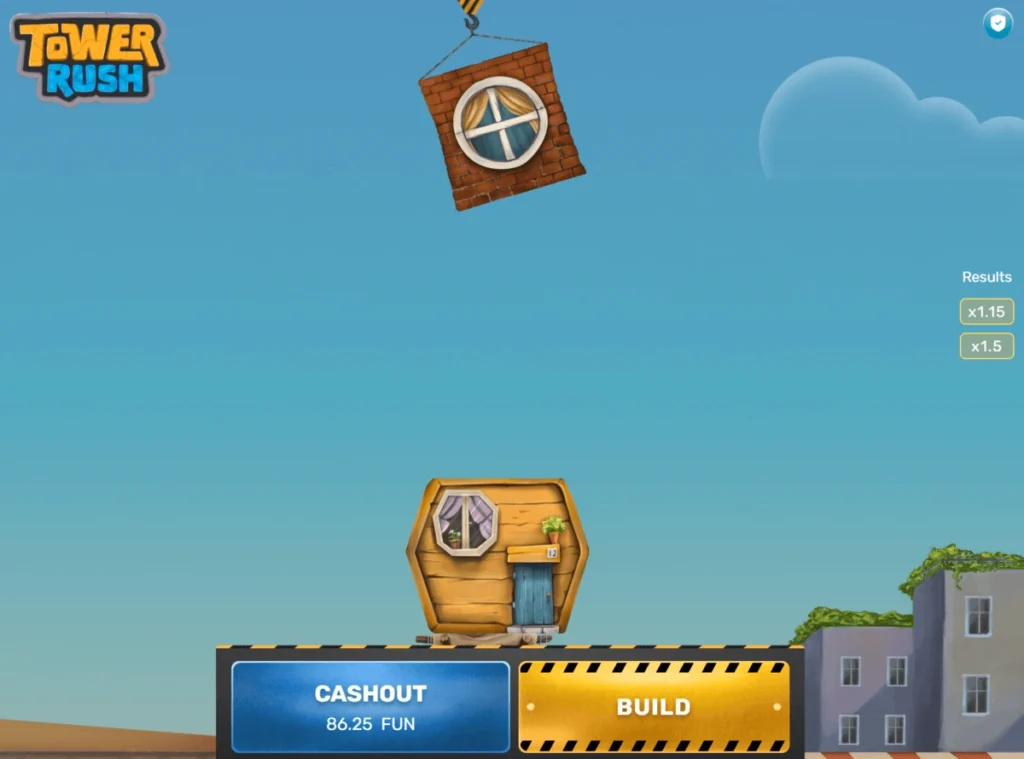
Tower Rush is our platform's tower-building crash game, published by Galaxsys, and it combines three named bonus floors with an official RTP range of 96.2% to 97.6% and browser access on almost any modern screen. This homepage gathers everything Tower Rush stands for in one place: what the game is, how each floor behaves, how the bonus features work, how the mathematics behind the multiplier really functions, and how the free Tower Rush demo can be explored without spending anything at all.
Tower Rush Quick Facts
Start With These Three Tower Rush Essentials
Every floor is a new decision. A completed floor does not guarantee the next one. After each success, the displayed value is reviewed before Build is selected again. The tower's height records what has already happened. It does not reveal what will happen next, and no amount of study of the tower's shape changes the mathematics of the floor still to come.
RTP is long-term mathematics. The official range of 96.2% to 97.6% describes theoretical long-run return. It does not promise a specific result from ten, fifty or one hundred attempts. At those RTP values, the corresponding theoretical house margin ranges from 2.4% to 3.8%, and that margin is already built into the values shown on screen rather than charged as a separate fee.
Predictors cannot guarantee results. No Tower Rush predictor receives the hidden information needed to know the next random result. Telegram bots, modified APK files and paid signal groups should not be treated as legitimate prediction tools, because a random number generator does not expose its next output to any outside application.
What Is Tower Rush?
Tower Rush is an online tower-building title published by Galaxsys, part of the Digitain group. A round begins with a starting amount and a request for the first floor. When that floor succeeds, the structure becomes taller and the current cumulative value changes. The next step is always optional. Cash Out ends the sequence and secures the displayed value. Build requests another floor and leaves the active result exposed to a possible collapse.
This creates a simple but effective game rhythm: start, build, review and decide. The interface avoids complicated paylines or symbol combinations, which allows the central action to be understood quickly even by someone seeing Tower Rush for the very first time. The full sequence is explored in more depth on our how-to-play guide, but the essential loop is short enough to describe in a single sentence: each floor that stands raises the value, and each floor that fails ends the round.
A Fast Tower Multiplier Game
Tower Rush is classified on the official Galaxsys website under Fast Games and described in its details as a Turbo Game. Comparison sites and communities also use terms such as crash game and multiplier game, because the active value remains exposed until it is secured. All of these labels describe the same underlying idea: a stake is placed on a sequence of uncertain events, and the return grows with each event that resolves in the sequence's favour.
The game does not use a traditional continuous crash graph. Instead, risk is divided into individual construction stages. A successful floor produces a visible pause, and that pause is a natural decision point. Tower Rush therefore offers more distinct moments of choice than a format in which a multiplier rises continuously until the round ends under its own momentum. Each of those moments belongs entirely to the person at the screen, which is why discipline matters more here than raw reaction speed.
The Galaxsys Product Record
Galaxsys lists the release date as 28 February 2024. The provider also publishes the RTP range, the three bonus-floor names and separate browser demonstrations for mobile and desktop. These first-party details matter because unofficial sources frequently repeat different figures. Some pages claim a December 2024 release or a 98.5% RTP without identifying any current product configuration, and those numbers cannot be traced back to a verified build.
The information panel inside the active version of Tower Rush remains the final reference. If the panel's details differ from a third-party page, the panel wins. That single rule resolves almost every conflict between descriptions of Tower Rush, because the panel travels with the game itself rather than with whatever a marketing page happens to say.
Why the Tower Can Keep Growing
Galaxsys describes the possible number of floors as limitless. There is no stated fixed top floor at which the visual structure must end. Limitless does not mean easy to reach, however. Every additional floor adds another unresolved event, and the probability of completing several events in sequence is always lower than the probability of completing only one.
The open-ended tower creates aspiration, while cumulative risk limits how often very tall sequences actually occur. That tension between an unbounded ceiling and a falling survival probability is the core design idea of Tower Rush, and it explains why the game can feel both generous and unforgiving within the same session.
Tower Rush Specifications
| Product Detail | Tower Rush Information |
|---|---|
| Product name | Tower Rush |
| Provider | Galaxsys |
| Group connection | Digitain |
| Official release | 28 February 2024 |
| Official category | Fast Games and Turbo Games |
| Main mechanic | Build floors and manage a cumulative value |
| RTP range | 96.2% to 97.6% |
| Theoretical house margin | 2.4% to 3.8% |
| Named bonuses | 3 |
| Bonus names | Frozen Floor, Temple Floor and Triple Build |
| Maximum tower | No fixed floor limit stated |
| Randomness | RNG technology |
| Verification | Provable fairness |
| Mobile support | Browser-based Android and iOS access |
| Desktop support | Yes |
| Provider demo | Yes |
| Supplier licence displayed | MGA/B2B/592/2018 |
How a Tower Rush Round Works Floor by Floor
Understanding Tower Rush becomes much easier when a single round is broken into its smallest pieces. Every round follows the same order of events, and the meaning of each button never changes from one session to the next. What follows is the full life of a round, described stage by stage without any reference to luck, timing or skill, because none of those three factors influences the outcome.
The Opening Stage
A round opens with a stake and a starting value. This first figure is the baseline against which every later decision is judged, and it is the number that the cumulative multiplier begins from. Nothing has been exposed yet, and no floor stands. The opening stage is the calmest moment of the round, and it is also the only moment at which the entire sequence is still purely potential.
The Build Button
The Build button requests another floor. When placement succeeds, the tower grows by one stage and the cumulative value updates to reflect the new total. When placement fails, the round collapses and the active value is lost. The Build button is the only control that adds risk to an active sequence, and it is therefore the button that deserves the most thought before it is pressed.
It is worth stating plainly what the Build button is not. It is not a timing challenge, a reflex test or a hidden pattern to be memorised. The result of each request is generated by random number technology and is not influenced by the exact millisecond of the press, the pressure applied to the screen, the model of phone in use, or the number of consecutive successes already recorded. The Build button carries no feedback loop that a decision at the screen could exploit.
The Cash Out Button
The Cash Out button ends the sequence and secures the displayed value. It is the only control that closes an active round on favourable terms, and its importance grows with every floor that stands. After a single successful floor the decision is small; after several successful floors the same button protects a much larger figure. Cash Out does not gamble. It resolves.
The Review Moment
Between a successful floor and the next decision there is a natural pause. That pause is the single most valuable feature of the Tower Rush design, because it allows the displayed value to be read and compared against a stopping point chosen in advance. A rule made before a round is almost always easier to follow than a decision made while watching a tower grow, and the review moment exists precisely to allow that pre-made rule to be applied calmly.
The Three Tower Rush Bonus Floors in Detail
Tower Rush carries three named bonus floors, each of which changes the shape of a round in a different way. None of them changes the randomness of the underlying events, and none of them can be triggered on demand. They appear as part of the game's own flow, and the current rules panel inside the active version remains the authority on exactly how each one behaves in the build on screen.
Tower Rush Bonus Floors

Frozen Floor
Frozen Floor introduces a protection-themed feature. When the active rules preserve a current value, the protected amount can change the consequence of a later collapse. The rules should be read before any assumption is made about what has been locked. Protection may apply to a specific value, to a particular point in the sequence, or to a single stage rather than the whole tower.
After the feature resolves, the protected state is compared with the session limit rather than treated as a reason to extend it. A protection feature can reduce a particular consequence without making future floors predictable, and it should never be read as a signal that the next floor is more likely to succeed. The value of Frozen Floor lies in what it preserves, not in what it promises.
Temple Floor
Temple Floor introduces a separate themed event that may be displayed through a roulette or segmented wheel. A wheel containing equal-sized visual segments does not automatically assign equal probability to every outcome, because digital games can apply hidden mathematical weights behind any visual design. The rules or paytable should identify the outcomes that are genuinely available, and the visual size of a segment should not be read as a statement of its likelihood.
Screen tapping cannot select a preferred segment, and repeated taps during the animation change nothing about where the wheel stops. Temple Floor is a presentation of an event that has already been determined by the random number generator, not an interactive skill test. The correct way to read it is as a bonus stage whose outcomes are defined in the rules and whose result is fixed before the animation begins.
Triple Build
Triple Build adds several floors through one feature sequence. It increases the tower's visible height more quickly than standard one-floor construction, which can make a round feel dramatically faster. It should not be assumed that three floors create a fixed three-times multiplier, because visual floors and mathematical multipliers are two different measures and are not interchangeable.
The updated cumulative value is reviewed when the feature finishes, rather than estimated from the number of stages drawn on screen. A successful Triple Build does not improve the probability of the next ordinary floor, and it does not make a collapse less likely simply because more floors were added at once. Triple Build changes pace and presentation, not the mathematics of repeated independent events.
Tower Rush RTP and Odds
The official Tower Rush return to player range is 96.2% to 97.6%. This figure is a mathematical property of the game's long-run design rather than a feature that can be switched on, and it applies across an extremely large number of resolved rounds.
What RTP tells us. RTP provides long-term mathematical context. It compares total theoretical returns with total resolved stakes across a sample far larger than any single session could produce. It does not predict the result of one round or one session. A result can finish above or below the published percentage by a wide margin, and both outcomes are entirely consistent with the same RTP figure.
What the house margin means. The margin is embedded in the mathematical model of Tower Rush. It is not shown as a separate charge, deducted as a fee, or applied at the moment of a cash out. The margin is simply the difference between the long-run return percentage and a full 100%, and it exists in every regulated game of this type regardless of the provider.
| Official RTP | Theoretical Margin |
|---|---|
| 96.2% | 3.8% |
| 96.6% | 3.4% |
| 97.0% | 3.0% |
| 97.6% | 2.4% |
Within the published range, a configuration closer to the lower end carries a slightly larger theoretical margin and a configuration closer to the upper end carries a slightly smaller one. The difference between the two ends of the range is smaller than is often assumed about crash-style games, and it is measured over millions of rounds rather than within any observable session. This is why the RTP range is best understood as a description of the model, not as a lever that changes how a particular evening unfolds.
Tower Rush Probability and Why Short Tests Mislead
Suppose twenty demo attempts produce several tall towers. That does not prove the game is returning more than its published RTP. A different twenty-attempt sample could contain many early collapses, and both results can occur comfortably within ordinary random variation. Short samples are dominated by variance, and variance is exactly the thing that long-run percentages are designed to average away.
Some pages claim that one trap always creates a 66.6% floor-success rate and that two traps always create 33.3%. Those figures require three equally weighted choices at every floor, and if the live rules do not confirm that model then presenting the percentages as official is misleading. The safest description is relative rather than absolute: lower supported settings produce steadier patterns, while higher settings produce sharper volatility. Neither setting changes the fundamental randomness of a single floor.
How Compounding Multipliers Work
Tower Rush multipliers combine cumulatively. Each successful floor value is multiplied into the current sequence rather than added to it, which is why later floors move the total so much further than early ones. Consider a Rs 200 virtual example built purely to illustrate the arithmetic.
| Event | Multiplier | Calculation | Virtual Result |
|---|---|---|---|
| Start | 1.00 | Rs 200 x 1.00 | Rs 200 |
| Floor 1 | 1.20 | Rs 200 x 1.20 | Rs 240 |
| Floor 2 | 1.40 | Rs 200 x 1.20 x 1.40 | Rs 336 |
| Floor 3 | 1.60 | Rs 200 x 1.20 x 1.40 x 1.60 | Rs 537.60 |
These numbers explain the calculation only. They are not fixed Tower Rush values or promised results. The cumulative design makes later decisions feel more important, and that feeling is accurate in one narrow sense: the value at risk really does grow. When another Build selection is made, the value created by the full successful sequence is exposed again, which is why the size of the protected total rather than the number of floors is the honest measure of a round.
A Worked Tower Rush Multiplier and Bankroll Example
Multiplier tables are abstract until they are attached to a specific plan, so it helps to walk through one worked example from start to finish. The example below uses virtual figures and a fixed stopping rule, and its only purpose is to show how a pre-committed plan behaves through a mixed sequence of successes and a collapse.
Imagine a session limit of Rs 2000 held as virtual credits, split into ten portions of Rs 200 each. Before the first floor of any round, a stopping rule is fixed: cash out at roughly 1.7 times the starting value, or end the round at the first collapse, whichever arrives first. The rule never changes mid-round, because changing a rule while a tower is growing is the single most common way a plan is abandoned.
| Round | Floors Completed | Outcome | Virtual Effect (Rs 200 stake) |
|---|---|---|---|
| 1 | 3 | Cashed out at 1.70x | +Rs 140 secured |
| 2 | 1 | Collapsed on floor 2 | -Rs 200 |
| 3 | 2 | Cashed out at 1.68x | +Rs 136 secured |
| 4 | 4 | Cashed out at 1.72x | +Rs 144 secured |
| 5 | 0 | Collapsed on floor 1 | -Rs 200 |
Across the five rounds the plan produced a small net movement, and the shape of that movement is the real lesson. Three wins did not cancel two losses in a way that could be predicted in advance, because the order and size of wins and losses is what randomness controls. A fixed stopping rule did something more useful than improving the odds: it made the session readable and bounded, so that the end of the tenth portion was a natural finish rather than a decision that had to be made under pressure.
Nothing in that example should be read as a strategy that beats the house margin. The theoretical margin of 2.4% to 3.8% is still present in every round, and over a very large number of rounds it is inescapable. What a plan changes is the size and timing of the swings, never their long-run average. Tower Rush rewards a plan for the same reason it punishes its absence: the exposed value is easy to read and easy to abandon too late.
Tower Rush Risk Settings and Lane Configuration
Some builds of Tower Rush expose a risk or difficulty control before a round begins. Where such a control is present, it changes the balance between the frequency of a successful floor and the size of the reward attached to it, but it does not remove the randomness of any single floor. A lower setting tends to produce steadier progression and smaller increments. A higher setting tends to produce sharper variation and larger increments when floors hold.
The honest way to read these settings is as a description of the volatility curve, not as a difficulty that can be overcome through practice. There is no setting on which a floor is more likely to hold because of something done at the screen. Changing the setting changes the shape of the reward distribution across many rounds, and that is the whole of its effect.
What a Fair Configuration Looks Like
A fair configuration of Tower Rush is one whose rules panel states the active RTP, the available bonus-floor behaviour and the outcome set for any wheel-style feature without hiding them behind a deposit screen. Fairness in this context is not a feeling about a session, it is a property that can be inspected. If the RTP is disclosed, if the bonus outcomes are defined, and if the randomness is described as provably fair, then the configuration is transparent in the way that matters.
What a fair configuration never does is guarantee an outcome. Transparency and predictability are different things, and Tower Rush is transparent about its mathematics while remaining unpredictable in every individual round. Those two facts coexist comfortably, and treating them as a contradiction is one of the most common misunderstandings about games of this kind.
Reading the Randomness Claim
Tower Rush is described as using RNG technology with provable fairness. An RNG is a computer process that produces results with no discernible pattern, and a provable-fairness claim means that the result of a round can be checked after the fact against a mathematical commitment made before the round ran. Neither claim makes a floor more likely to hold, and both claims are about verifiability rather than about winning.
The practical meaning for anyone reading a round history is simple: past floors have no bearing on future floors. A run of successes does not make a collapse overdue, and a run of collapses does not make a success due. Randomness has no memory, and the tower remembers only the shape it was left in, never the odds of the next stage.
Tower Rush Demo Mode
The Tower Rush demo mode uses virtual credits and provides access to the building interface without requiring a deposit. It is the recommended starting point for anyone who wants to understand how the game behaves before any decision involving real money is even considered, and in India it is the appropriate way to experience Tower Rush in full given the national legal position set out further below under the India section.
Learn the controls. The first attempts are best spent identifying Build, Cash Out, game history, settings and fairness information. The goal is not to produce the tallest tower but to understand how each control changes the session. A round that ends quickly teaches as much as a round that climbs high, because the collapse is the event the controls exist to manage.
Compare risk settings. Keeping the virtual amount unchanged and switching only one setting at a time makes changes in volatility easier to observe. A small sample cannot establish exact probabilities, but it can reveal how the interface presents different lanes and how the reward increments shift with the setting.
Check mobile performance. Opening the demo on the device and connection normally used for browsing confirms that the buttons remain visible and responsive. If controls freeze, lag or become difficult to read, the session should be closed rather than continued, because an unresponsive interface is the wrong environment for any decision.
Set a practice limit. A fifteen-minute or twenty-attempt limit, with the session closed when either is reached, keeps the demo a learning tool rather than a routine. A free balance removes financial risk, but it does not remove the possibility of repetitive play. See the full free demo walkthrough for more detail on structuring a first session.
Tower Rush Strategy and Discipline
The complete Tower Rush gameplay loop can be understood in six stages. A virtual-credit session should be used first so the interface can be studied without any financial pressure, and the same six stages apply whether the balance is real or imaginary.
- Open the verified demo. Beginning from the official Galaxsys product page or another verified demo route keeps the session on a genuine build. The spelling of the domain is checked before the game loads, because a single altered character is a common way a clone is presented.
- Read the rules and RTP. The information panel is opened to confirm the displayed RTP, the current version, the available risk controls and the bonus-floor behaviour. Anything the panel does not state should not be assumed.
- Set a virtual amount. An amount is chosen from the demo balance, and a consistent amount makes multiplier calculations easier to follow across rounds. Changing the stake mid-session blurs the arithmetic and makes a plan harder to judge.
- Select the available risk setting. Some implementations show trap or difficulty controls. Lower settings may create steadier progression, higher settings sharper variation, and only one setting is changed at a time so its effect can be read.
- Press Build. Build requests the next floor. When placement succeeds, the structure grows and the active value updates. Timing, screen pressure and phone model do not control the result, and treating them as though they might is the fastest route to superstition.
- Cash Out or request another floor. After a success, the active value is compared with the stopping point chosen before the attempt. A predetermined rule is easier to follow than a decision made while watching the tower grow, and following it is the entire point of having one.
Why a Stopping Rule Matters More Than a Strategy
There is no Tower Rush strategy that changes the probability of a floor, because the floors are independent and randomly generated. What can be controlled is the size of the exposure and the point at which a round ends. A stopping rule fixes both of those in advance, and in a game where the value at risk grows with every success, fixing them in advance is the only genuine form of control available.
Two rules cover most situations. The first is a target: a round ends when the displayed value reaches a set multiple of the starting amount, regardless of how many floors remain available. The second is a floor cap: a round ends after a fixed number of successful floors even if the target has not been reached. Either rule alone is useful. Both together mean that neither greed nor frustration can quietly rewrite the plan midway through a tower.
Is Tower Rush Real or Fake?
The Tower Rush real game is a verified Galaxsys product. Its first-party page lists the release date, the RTP, the main features and the demo routes. Fake products use the same name without any legitimate provider connection, which is why a short verification routine is worth running before any Tower Rush title is trusted.
Check the developer name. The original product should identify Galaxsys. An unnamed developer or an invented company is a warning sign. The interface is compared with the official product gallery rather than judged from a single copied logo, because logos are trivial to reproduce and prove nothing on their own.
Open the information panel. A genuine build should provide rules, RTP details and fairness information. A page that hides these details while displaying only deposit buttons deserves caution, and the absence of an information panel is itself a piece of information.
Review the website address. Spelling, HTTPS and the domain owner are checked where possible. Extra words and unusual subdomains can be used to imitate a recognised product. HTTPS secures a connection, but it does not prove that the business behind the connection is trustworthy, and a padlock should never be mistaken for a licence.
Verify licence information. Galaxsys publishes Malta supplier licence MGA/B2B/592/2018. This identifies the regulated supplier. A separate site cannot prove its own legitimacy by copying that number, and licence details must match the business and domain shown in the regulator's records rather than merely appearing somewhere on a page.
Tower Rush Predictor, Hack and Fake APK Risks
No Tower Rush predictor app, Telegram signal or modified APK can guarantee an unrevealed RNG result. Scam marketers publish successful guesses and hide failed ones. A signal seller can send different forecasts to several groups, then promote only the group that happened to be right. Paid access does not provide secret knowledge, it only makes an unsupported claim more expensive.
Modified APK files. A Tower Rush APK distributed through private messages can request access to SMS, contacts, notifications, photos or accessibility services. These permissions can expose personal data and authentication codes, and no legitimate browser-based game requires them. The file should not be installed, and the request itself is a reliable warning sign.
Fake earning balances. An imitation app may show a large balance and then demand tax, verification or withdrawal fees. No further money should ever be sent to unlock an uncertain amount, because the unlock is the scam and the balance does not exist. Evidence is saved and the incident reported through official cybercrime channels at 1930 or cybercrime.gov.in.
Recovery-fee promises. A second wave of fraud often targets people already affected by the first, offering to recover lost money for an upfront fee. Genuine authorities and platforms never ask for a payment to release a refund, and any message that does should be treated as a fresh attempt at the same crime.
Tower Rush Versus Aviator and Other Crash Games
| Feature | Tower Rush | Aviator | Spaceman-Style Games |
|---|---|---|---|
| Progress display | Floors added to a tower | Aircraft follows a rising curve | Character or object rises |
| Decision rhythm | Separate Build decisions | Continuous cash-out period | Continuous cash-out period |
| Named mid-round features | Frozen, Temple and Triple Build | No comparable tower-floor features | Depends on the title |
| RTP | 96.2% to 97.6% | Check the current Aviator panel | Check the selected product panel |
| Visual style | Construction and city theme | Minimal aircraft interface | Space-themed interface |
| Guaranteed predictor | None | None | None |
A completed floor creates a defined moment to read the active value, which can make a Tower Rush session feel more structured than a continuous crash curve. The additional decision points also create more opportunities to abandon a planned stopping rule, and that is the trade-off at the heart of the format. More interaction does not mean greater mathematical control.
Aviator uses a single rising curve and a direct exit decision, which suits a preference for continuous movement. Tower Rush suits a preference for staged progression and named bonus events, because its rhythm is punctuated rather than smooth. The right comparison is never a feeling about which game is friendlier, it is the actual provider, RTP and rules, and those differ from title to title even when two games look similar on the surface.
Tower Rush Payments, UPI and KYC in India
Questions about Tower Rush and money in India almost always come down to three things: which payment rails are discussed, what identity checks apply, and what the current law says. Each deserves a clear answer, and the answers are more sober than the advertising around crash-style games tends to suggest.
Payment Rails Discussed in India
Indian-facing pages frequently mention UPI, net banking, debit cards and prepaid wallets such as Paytm or PhonePe as ways to move money into a gaming account. A familiar payment logo does not prove that a platform is lawful, regulated or safe, and the presence of a national RuPay mark proves nothing about whether a business accepts it. Payment branding describes a rail, not a licence.
The most consistent warning sign is a request to transfer funds to a personal UPI ID described as a gaming cashier. A genuine regulated service never routes a deposit to an individual's personal handle, and a request of that kind should be treated as a strong indicator of fraud regardless of what the surrounding page claims.
Identity Checks That Apply
Where any online account is opened on a service that operates under a licence, identity verification normally applies. A typical process asks for a government photo ID, proof of address and, in some cases, a live photograph or a bank verification. The purpose of these checks is to confirm age, prevent duplicate accounts and satisfy anti-money-laundering obligations, and they are a normal part of regulated operation rather than an obstacle.
Age verification is not optional under any legitimate framework, and access is limited to adults aged 18 or over. Any service that skips age and identity checks entirely in order to move quickly to a deposit screen is signalling that it does not operate under meaningful oversight, whatever logos it displays.
The Current Indian Legal Position
India's Promotion and Regulation of Online Gaming Act, 2025 came into force on 1 May 2026. It prohibits online money games, their advertising and related fund transfers across India, including offshore services offered within the country. This national position replaces older descriptions that treated legality only as a state-by-state question.
Within that framework, the free demo is the appropriate way to experience Tower Rush in India. The demo involves no stake, no deposit and no withdrawal, and it allows the full building interface, the bonus floors and the fairness information to be studied without engaging any of the activity the law restricts. Nothing on these pages should be read as encouragement to move money onto any platform.
Tower Rush on Mobile: Browser Versus APK
Tower Rush runs in a mobile browser, and that one design choice resolves a surprising number of practical questions. No separate application needs to be installed, no store account is required, and no update has to be fetched before a session can begin. The game is loaded in the same way as any other web page, on Android or iOS, and it works the same way on a desktop screen.
Why No APK Is Needed
An APK distributed outside an app store carries none of the protections that a regulated store applies. It can request permissions to SMS, contacts, notifications, photos and accessibility services, and each of those permissions can be turned against the person who grants it. Because Tower Rush needs none of them, any file claiming to be Tower Rush and asking for them is not Tower Rush, however closely its icon resembles the game.
A browser-based game also avoids the storage and update overhead of an installed application, which matters on the devices that are most common in India. A stable connection improves how responsive the interface feels, but it does not change any mathematical result, and a weak connection can never cost a floor that was going to hold.
What to Check on a Mobile Session
Before any sustained session, the layout is checked in portrait and landscape, the Build and Cash Out controls are confirmed to be comfortably sized, and the information panel is confirmed to open without blocking the game. If the controls overlap, the text is unreadably small, or the panel will not load, the session is closed rather than continued, because a poorly rendered interface is not a safe place to make decisions.
How to Read a Tower Rush Licence and Game Information Panel
Most misunderstandings about Tower Rush come from reading marketing pages instead of the game's own panel. The information panel travels with the build on screen, and it is the closest thing to a primary source that a comparison site can point to. Learning to read it properly takes a few minutes and answers questions that no amount of third-party commentary can settle.
What the Panel States
A complete information panel states the active RTP, the version or build reference, the outcome set for any bonus feature, the stake range, and the fairness mechanism. Where a licence number is displayed, it identifies the regulated supplier rather than the site hosting the game, and Galaxsys publishes Malta supplier licence MGA/B2B/592/2018 for that purpose.
The panel is also where any disagreement between sources is settled. If a comparison page states one RTP and the panel states another, the panel is correct for the build in front of the screen, because the panel is generated by the game and the comparison page is generated by whoever wrote it.
What a Licence Does and Does Not Mean
A supplier licence such as MGA/B2B/592/2018 confirms that the supplier is regulated by the Malta Gaming Authority for business-to-business activity. It is a real and checkable fact, and it can be verified against the regulator's own records. What it does not do is transfer to any other site that displays the number, because a licence belongs to a specific legal entity and cannot be inherited by association.
The correct use of a licence reference is therefore as a starting point for verification rather than as a badge of trust. The number is looked up, the entity behind it is confirmed, and the entity is compared with the entity actually operating the service in question. Where those do not match, the licence reference is decorative rather than meaningful.
Tower Rush Session Limits and Self-Exclusion
Time limits and attempt caps are set before the first floor, never during a round, and they exist to make a session finite in a way that feels natural rather than punitive. A limit chosen in advance is a decision made by a calm mind about a future that has not yet happened, and it is far more reliable than a decision made while a tower is climbing.
| Limit Type | Purpose | Example Rule |
|---|---|---|
| Time | Bound the session | Close after 20 minutes |
| Attempts | Bound the exposure count | Stop after 20 attempts |
| Floor cap | Bound each round | End a round after 3 floors |
| Cooldown | Separate play from emotion | Pause at least 15 minutes |
| Self-exclusion | Remove access entirely | Block the account on request |
A cooling-off period is used after frustration or after an unplanned extension of a session, and it serves one purpose: to put space between an emotional moment and the next decision. Self-exclusion goes further and removes access altogether, and any service operating under a licence is expected to provide a route to it on request.
Recognising a Problem Early
The early signs of a problem are consistent and easy to name. Play that becomes secretive, play that continues past a limit that was set deliberately, borrowing to continue, and a mood that rises and falls with the results are all worth taking seriously. None of them is a moral failing, and all of them respond to tools such as limits, cooldowns and self-exclusion when they are used early rather than late.
A collapse never creates an obligation. The next result is random, and no rule of the game connects a loss to a future gain. Treating a collapse as a debt to be repaid is the assumption that turns a session of Tower Rush into something it was never designed to be, and it is worth naming plainly so that it can be recognised and refused.
Tower Rush Across India
Mobile-first browser access. The Tower Rush browser format works well for Indian audiences who rely on Android devices and mobile data, because it avoids the storage, update and permission requirements of an independent application. A stable connection improves interface responsiveness, but it does not change any mathematical result, and no connection quality can make a floor hold or fall.
INR and payment claims. Search pages may promote Rupee stakes, UPI, Paytm or PhonePe access for Tower Rush. A familiar payment logo does not prove that a platform is lawful, regulated or safe, and payment branding describes a rail rather than a licence. Money should never be transferred to a personal UPI ID described as a gaming cashier, and no extra charge should ever be paid to unlock a withdrawal, because that charge is the fraud itself.
The current Indian legal position. India's Promotion and Regulation of Online Gaming Act, 2025 came into force on 1 May 2026. It prohibits online money games, their advertising and related fund transfers across India, including offshore services offered within the country. This national position replaces older descriptions that treated legality only as a state-by-state question, and within it the free Tower Rush demo is the appropriate way to experience the game in India.
Tier-2 and Tier-3 city safety. Audiences outside the major metros are frequently targeted through local-language Telegram channels, WhatsApp groups and payment agents. A local phone number or a regional-language support agent does not prove legitimacy, and independent verification of the provider is the only reliable safeguard. Private payment arrangements should be avoided entirely, because no legitimate regulated service routes money through an individual's personal handle.
Tower Rush Frequently Asked Questions
What is Tower Rush?
Tower Rush is a Galaxsys tower game in which successful floors increase a cumulative value. After every completed stage a decision is made to secure the result or request another floor. It is classified under Fast Games and Turbo Games, and it runs in a browser with three named bonus floors.
When was Tower Rush released?
Galaxsys currently lists the official release date as 28 February 2024. Older or unofficial pages sometimes give a different date, but the first-party product record is the reference we rely on for Tower Rush release details.
What is the RTP of Tower Rush?
The official published range is 96.2% to 97.6%, which corresponds to a theoretical house margin of 2.4% to 3.8%. The exact configuration should be checked in the active game information panel, because that panel describes the specific build on screen rather than a general range.
Can Tower Rush be played for free?
Yes. Our demo mode uses virtual credits and provides full access to the building interface without any deposit. The free demo is the recommended starting point in India, and it allows the controls, the bonus floors and the fairness information to be studied before any decision at all.
Is Tower Rush real or fake?
The Galaxsys product is real and verifiable through the provider's own product record. Fake predictors, unknown APK files, clone websites and guaranteed-income applications may misuse the name, so the developer name, the information panel and the licence reference are all worth checking before a build is trusted.
How is Tower Rush different from Aviator?
Tower Rush uses separate floor-building decisions and three named bonus features, while Aviator uses a continuous aircraft multiplier interface with a single exit decision. The rhythm of Tower Rush is punctuated by each floor, which creates more distinct decision points than a smooth rising curve.
Does Tower Rush require a download?
No download is required. The official demo runs through supported Android, iOS and desktop browsers, and no APK is needed. Any file offered as a Tower Rush APK should be refused, because a browser-based game has no reason to ask for installation or permissions.
What are the three bonus floors?
They are Frozen Floor, Temple Floor and Triple Build. Frozen Floor is protection-themed, Temple Floor presents a themed event such as a segmented wheel, and Triple Build adds several floors through one feature sequence. Their exact effects should be confirmed in the current rules.
Can Tower Rush results be predicted?
No external tool can guarantee future random results. Previous attempts, tapping patterns and paid signal groups do not reveal the next outcome. A predictor receives none of the hidden information needed to know a floor, and any claim otherwise should be treated as a marketing tactic rather than a capability.
Does Tower Rush have unlimited floors?
Galaxsys describes the potential floor count as limitless, which means no fixed top floor is stated. Every additional stage still requires another successful result, and the probability of completing several events in sequence is lower than the probability of completing only one.
Can Tower Rush be played on Android?
Yes. The mobile browser demo opens in Chrome or another current browser without installing an independent APK. The browser route avoids the storage, update and permission requirements of an installed application and behaves the same way regardless of device model.
Can Tower Rush be played on iPhone or iPad?
Yes. The demo runs through Safari on supported iOS and iPadOS devices. No separate application is needed, and the same browser-based interface is used, so the controls and the information panel appear in the same places as on other platforms.
Is Tower Rush legal for real-money play in India?
India's national online-gaming law in force from 1 May 2026 prohibits online money games, their advertising and related fund transfers, including offshore services offered within the country. Within that framework the free demo is the appropriate way to experience Tower Rush in India.
Why do short test sessions give misleading results?
Short samples are dominated by variance rather than by the long-run RTP. A brief run of tall towers can appear well above the published return, and an equally short run of collapses can appear far below it. Both are consistent with the same RTP figure, which only becomes visible across an extremely large number of resolved rounds.
What should be checked before trusting a Tower Rush page?
The developer is confirmed as Galaxsys, the information panel is opened for rules and RTP, the website address is checked for spelling and unusual subdomains, and any licence reference is verified against the regulator's own records rather than accepted from the page that displays it.
Responsible Tower Rush Play
A time limit, an attempt cap and a stopping point are chosen before the demo is opened. A collapse does not create an obligation that the next attempt must repay, and the next result remains random regardless of how the previous one ended. The game is closed for at least fifteen minutes after frustration or an unplanned extension, because a pause is the cheapest and most effective tool available.
Tower Rush is not employment, an investment or a reliable source of income. It is a game with a published house margin and a random outcome, and it is honest about both. If play causes secrecy, anxiety, debt or conflict, the right response is to stop and to use blocking and self-exclusion tools rather than to attempt to play a way out of a difficult position.
| Personal Limit | When to Set It | Example Demo Rule |
|---|---|---|
| Session duration | Before opening the game | 15 minutes |
| Attempt count | Before first Build | 20 attempts |
| Maximum floors | Before each attempt | Fixed stage cap |
| Cooldown | After frustration | Minimum 15 minutes |
| Stop condition | Before play | End at first breached limit |
Tower Rush is entertainment and product information, not a source of income. In India, free confidential support is available from Aasra on 91-9820466726, the Tele-MANAS helpline on 14416, and 112 is the emergency number. Our responsible gambling guide lists tools and self-exclusion options in more detail.
Tower Rush Platform Information Notice
Tower Rush is our platform's game guide, and Tower Rush runs on our platform. The game facts, RTP figures and safety notes across these pages describe that product, and they are maintained so that the information about Tower Rush stays accurate and current. The Galaxsys name, the Tower Rush name and associated product names remain the property of their respective owners.
Current specifications are confirmed through the active game information panel, which travels with the build on screen and describes the exact configuration in use. For notes on platform choice more broadly, our online casinos page gathers the relevant context, and the FAQs handle the questions that come up most often.
Last reviewed: July 2026.